OUT NOW: MAR/APR ’26 ISSUE #179
News and insights from the movers and storers industry
Add a notification here… Get in touch »


27th March 2026
Dan Robins
8 mins read
Uncategorized

SSA UK’s new Chief Executive on standards, growth and technology.
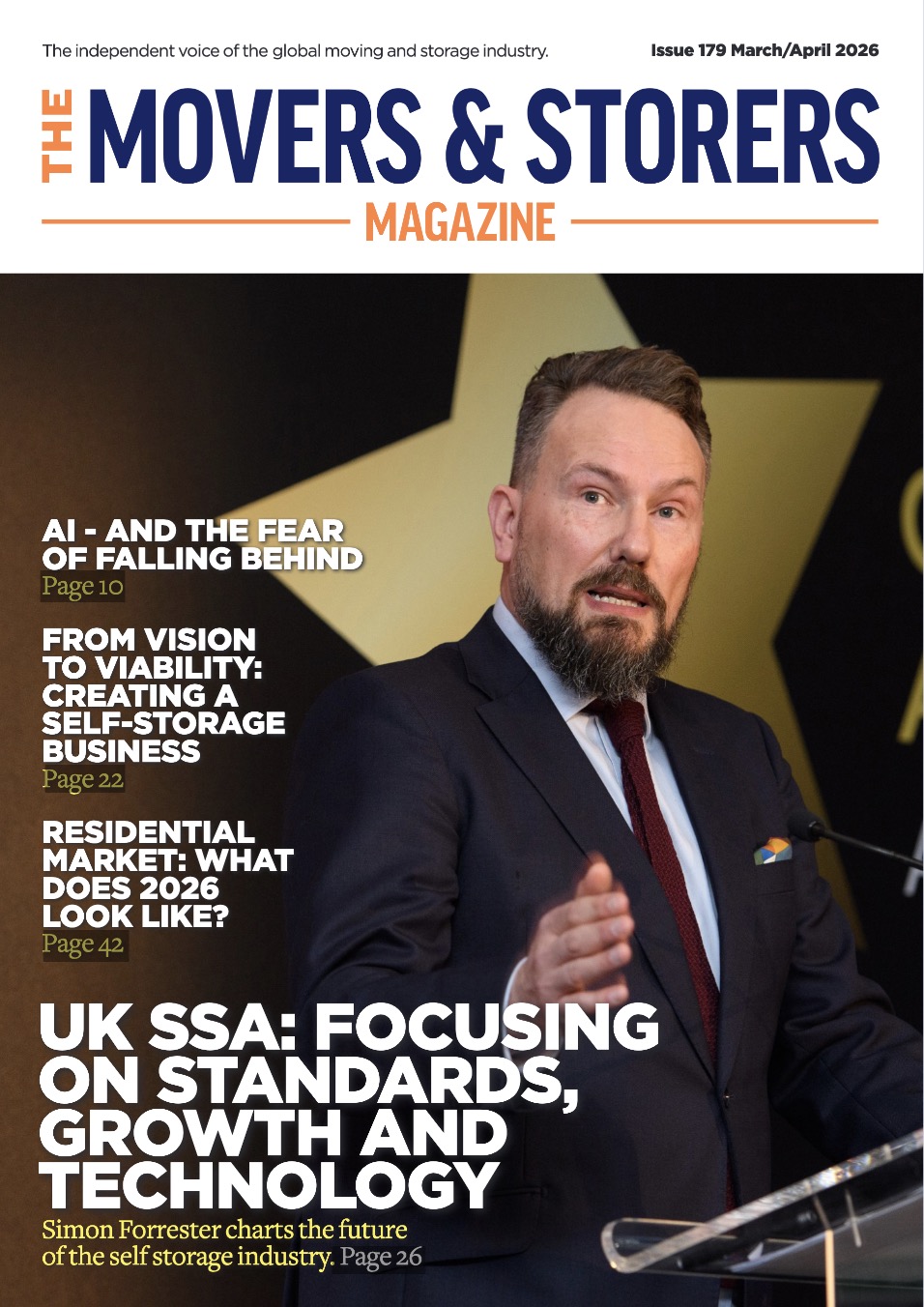
To mark Simon Forrester’s first six months as Chief Executive of the UK Self Storage Association (SSA), the Movers and Storers Magazine spoke to him about a wide range of topics, including the SSA and the future of the self storage industry.
M&S Magazine: What attracted you to the UK Self Storage Association role, and what did you see that made you think “I can move this forward”?
Simon Forrester: I knew my predecessor Renie Schafer from being in board roles for the same not-for-profit organisation, and I was really impressed with how he had helped to grow and mould both the self storage sector and the association. He gave me a call to say he was moving on and encouraged me to apply. I genuinely wasn’t looking for a new job, but the more I looked into it, the more attractive the sector and the challenges of the role became. The culture of the membership is one that embraces change and opportunity. As a sector, it’s still in its infancy – it’s only been around in its current format for half a century, and has much further to go.
M&S Magazine: What have you learned so far that surprised you about the sector or the association’s role? Have you identified any “top priorities”?
Simon Forrester: I think the sector needs to ensure we remain self-regulated by raising and maintaining standards, communicating the value of self storage to the public, and demonstrating what ‘good’ looks like. The removals industry has done this well, and we are working on a structured audit process against the European Standard for self storage (BS EN 15696).
M&S Magazine: Is there any way of measuring success in the first year?
Simon Forrester: I think the goal is “evolution” rather than “revolution” – I have a strong foundation to work from, and the Board are meeting soon to revise the strategy, based on input from the staff team and members. One of the best things I could give to all our members is to grow the self storage ‘pie’. In the US the market is much larger (12% versus 4% uptake in the UK) because more of the public understand the value of, and therefore utilise, self storage.
M&S Magazine: Have you identified any particular “member needs” as being particularly urgent right now – for example: planning, rates, staffing, energy costs, security, customer acquisition, regulation, technology?
Simon Forrester: I’m in the middle of a programme of visits to operator and supplier members which has been really enlightening. The main challenges for members are around regulation; the common ones across all sectors (planning, business rates, energy costs, recruiting and retaining skilled people) and those more specific to our sector, such as pricing transparency and customer churn – which surprisingly isn’t a negative. If a storage business is at 100% capacity, it’s doing something wrong.
M&S Magazine: Where is the focus – e.g. advocacy, standards, training, market intelligence, or something else?
Simon Forrester: Our medium term focus is standards, which in turn will support our advocacy work. We are already fairly strong on industry statistics. Our industry data with Cushman & Wakefield (new version to be published April 2026) is an excellent resource, supported by other benefits like Property Week digital subscriptions and YouGov data on public sentiment. However, I think there is more we can do using AI to present the data and our extensive portfolio of member resources in a form whereby members can interrogate it to answer their specific questions and help them to make more informed business decisions.
M&S Magazine: Anything specific on improving membership value?
Simon Forrester: Our goal as an association is to put our suppliers and operators in the same room to have structured discussions where each learns from the other. That’s why our Telford Conference (29-30 April) is so important. We’ve changed the structure of our events and training offering to catch companies at the start of their journey into self storage. The Conference has a theatre with seminars across the two days specifically designed to help new entrants with the challenges they face – everything from overcoming planning issues to selection of a space management system, from insurance products for customers to securing the site using AI oversight.
Looking at the future, self storage is blending into removals, and vice versa. From the conversations I had with attendees at the Movers and Storers Show, many removals companies are looking to diversify into self storage, and the returns on investment are definitely there. With average revenue of over £29 per square foot of space across around 3,000 UK sites, the sector has a turnover of £1.2 billion – and there is still a lot of room for new entrants.
We are seeing more modular crated storage solutions entering the market – the true hybrid between removals and self storage. In the future I can see a role for autonomous delivery of stored goods; for example, you tell your AI agent to book a round of golf, and it delivers your clubs from storage to the course. All this tech is already there – the opportunity is in getting it to work together.
M&S Magazine: Do you have any examples of where you think standards matter most today?
Simon Forrester: We’ve developed a watertight customer contract for members to use – it’s been live-tested over 30 years and offers operators a bullet-proof template for customer agreements, tailored to the law in Scotland, Northern Ireland and England and Wales. This, backed up with around 200 other documents, makes up the core of our offer – all the documents you need to run a successful self storage business. Our standards focus on contractual issues, site security, operations and HR, response to enquiries, and insurance and risk management.
M&S Magazine: Where is UK self-storage growth coming from now?
Simon Forrester: Without wishing to ‘jinx’ things, self storage is generally recession-proof. The mix varies across the country dependent on demographics, but with a core of around a third to half being business users, and the rest made up by the public. Smaller houses, more apartment living and more single-person households, coupled with an increasingly entrepreneurial demographic, means self storage demand is growing. The main constraints on new site development are around availability of land, planning approvals and for smaller start-ups, financing. We are working to address all three.
M&S Magazine: Do you expect consolidation to accelerate, and what does that mean for competition and customer outcomes?
Simon Forrester: Many owners still have small portfolios; institutional capital sees roll-up, professionalisation and margin-expansion opportunities via third-party management companies. There are one or two larger operators that might be acquired, but there are new entrants on a weekly basis – and they are expanding rapidly. Most have multiple sites within three years. Investor appetite is broad; private equity, REITs, developers and lenders are all active, and the demand is there as self storage is a very stable offer.
M&S Magazine: Which technologies will most change operations in the next 2 to 3 years?
Simon Forrester: The number of unmanned stores continues to increase. In our recent survey 15% of stores did not have a single staff member permanently on site, but I would expect that to double within three years. Tech-enabled access, with lower staffing costs often sited in smaller or secondary locations, appeal to price-sensitive and digitally confident users.
M&S Magazine: What’s your stance on data? Should the SSA UK build better sector metrics?
Simon Forrester: Our sector has great knowledge, but there are some silos – I’d love an open conversation with our supplier base about a shared knowledge pool or data stack. 68% of businesses are actively using AI, which is a strong base for further integration. Our call for speaker topics at our Telford Member Conference yielded AI integration as the number one request, and the agenda reflects that.
M&S Magazine: How is the current market and where do you see future demand?
Simon Forrester: The removals sector is very well-positioned to transition to self storage. Their sites are generally flat land with existing buildings and hard standing, located on good roads close to population centres, and probably with the correct planning code (B8) which is half the battle. Removals businesses looking to potentially diversify into self storage should come to Telford and meet the sector – we’re a friendly bunch!
All the research shows the UK market is expected to grow by at least 40 per cent in the next 10-12 years. This means there is scope and space for both new entrants, and for existing operators to grow and develop. Our future as a sector is strong, and we welcome new entrants.
To attend the SSA UK Telford conference (29-30 April) at a special discounted rate, visit SSA UK Level Up Conference 2026 and use the code Movers26.




News and insights from the movers and storers industry